

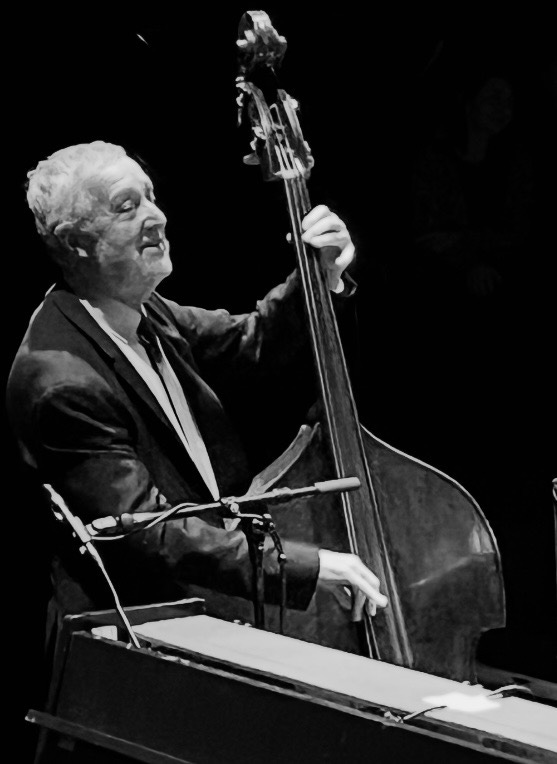
(Dave Green at The Cockpit, London, November 2024. Photo: John Earls, 2024)
The word ‘legend’ is often overused. But Dave Green really is a British jazz legend. In a career that has spanned over 60 years, the bassist has played with some of the all-time greats including Sonny Rollins, Roland Kirk, Coleman Hawkins, Ben Webster, Ronnie Scott, Tubby Hayes, Humphrey Lyttelton, Stan Tracey and Charlie Watts (who was a boyhood friend and neighbour in North West London) to name just nine in a very long list. He is also now the only person still alive to have appeared on the original 1964-66 run of the classic BBC jazz TV programme Jazz 625, playing in an ‘All Star Jam Session’ with Ronnie Scott in 1964 and a session with Big Joe Turner and the Humphrey Lyttelton Band in 1965.
At 84, Dave is still very active on the jazz scene including playing live with the Scott Hamilton Quartet, Pocket Ellington and the Matyas Gayer Trio. I’ve met Dave quite a few times and, apart from his supreme musicianship, there are two things that strike me about him. Firstly, he has a superb memory and recollection for his jazz story (and great anecdotes to go with it). Secondly, he is one of the nicest and most generous people I have met. He is, as they say, the real deal.
I spent a lovely couple of hours chatting to him for Hanging Out a Window over coffee and panini at a café near his home in Ruislip, West London. The conversation was wide ranging and easy flowing. In the first of two parts of this interview (part two will be published next week), Dave talks about his formative years. I started by asking him if he had music around the house when he was growing up.
“Yeah, my mum was an avid radio listener. I remember Housewives’ Choice being on, that started in 1946, when I was four. And I remember, I must have been about two or three, listening to Music While You Work, which was broadcast during the war, every day with a different band. And some of it was quite jazzy, but I wouldn’t have known the difference then. Music was in my life right from a very early age.”
Dave’s playing of music started with skiffle and a tea-chest bass. Did he know at that time that the bass was what he wanted? “I guess so. I must have done. This would be when I was about 13. The skiffle thing took off about 1956, Rock Island Line and all that stuff, and my school friend Brian Humphries played a bit of guitar and we thought we would just get a skiffle group together with a guy called Jim Snowden who played washboard. Just the three of us initially and me with the tea-chest bass.”
And then you and Charlie [Watts] were in a band? “That was a bit later. Charlie was never in the skiffle group. Living next to him we kind of grew up in tandem. We discovered jazz together. It was like a pre-ordained thing almost. I started going to the record shop and buying ‘78s, then gradually he started buying LPs, so we built up this collection of jazz, and that’s how it all started really. Eventually, his dad bought him a drumkit, and I wanted to get a real bass because I wanted to graduate from the tea-chest. I was definitely bass conscious.
“Through doing interval gigs, I met Harvey Weston, who said he wanted to get a different bass, and his bass was up for sale. I was doing a paper round – I was about fifteen – after school, and saved money and bought this bass for £15. I got a very cheap How to Play Double Bass - still got it at home - to start me off. I started practising scales and stuff. The first ‘78 I bought was the Jess Stacy Trio, recorded in 1935 with Israel Crosby on bass - he was only sixteen when he made the record – but it was lovely. I managed to copy the solo that he played on the record, very simple solo, but I copied that. Charlie and I, kind of learning from listening to records and stuff.
“A few months later, I saw an advert in the Melody Maker with a band leader who was advertising for bass and drums. And we - I mean, we were very basic, just playing to records in our bedrooms - said, ‘Let’s go for it. See what happens’. So, suddenly we went down to the Welsh Harp pub in West Hendon. Met Brian Jones [the trumpet player not the Rolling Stone], everybody called him ‘Joe’. And we thought, ‘It’s an audition. We’re never going to get through this’. But nobody else turned up! So, he said, ‘Okay, the gig’s yours! We’ve got a gig next Thursday at the Masons Arms in Edgware. Turn up at 7 o’clock. We’ll see what happens’. And that’s what we did. And we stayed with that band, me and Charlie, for 18 months. We literally learned on the job. We were listening to a lot of jazz, but actually doing it is another thing. But both of us had a certain amount of natural talent. So, it kind of grew on that, and Brian was very patient, he kind of nurtured us along. He was very kind to us, really.”
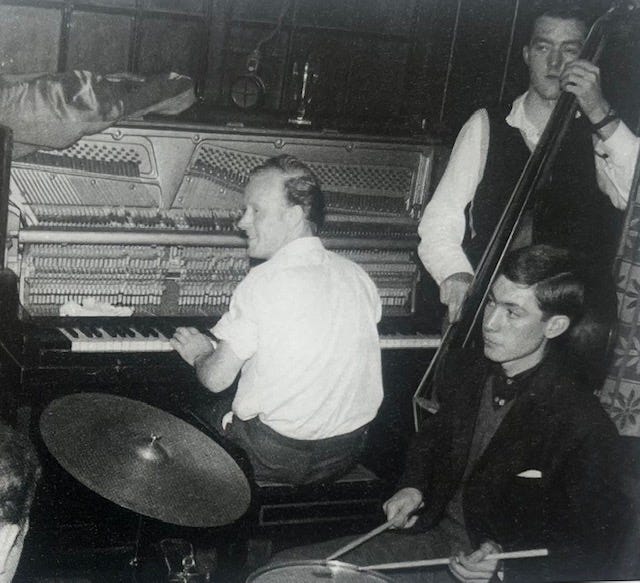
(Dave Green on bass and Charlie Watts on drums, in the Joe Jones Seven, at Masons Arms, Edgware, 1959. Picture courtesy of Dave Green)
Whilst playing in the band Dave worked at day jobs including in a hardware store in Edgware (but the products exacerbated his asthma and eczema at the time) and then as a cashier’s assistant. His gigging included playing with drummer Peter Prince’s trio at age 17 in spots such as the Ivy Club in West Kensington and pubs on the fringes of London. Often carrying his bass on the train, Dave was constantly learning and building up his experience playing with the likes of saxophonists Kathy Stobart, Dick Morrissey, Ronnie Ross and Don Rendell. He turned professional in 1963.
“A friend of mine - we both used to go down to Ronnie Scott’s when Ronnie’s opened in 1959 - who played trumpet, got a job, a summer season in the beginning of 1963, Butlins holiday camp or something. So I thought, ‘If he can do it, I can do it’. So, I was, if anything comes I was going to give up the day job and go do whatever it was. It might have been Butlins, it might even have been a gig on the boats or something like that.”
And what a ‘first gig’ it turned out to be at the age of 21! “I got this call from Peter Shade, a well-known vibraphone player, who offered me this gig in the south of France for six weeks. So, I immediately took it. It was travelling down to France in an old American Buick car with the bass, drums, everything. Very exciting. The gig was in a 12th century castle in a place called Dieulefit, quite a small town near Montélimar. It was magic. A wonderful start.”
The trip lasted longer than initially planned. After the gig in France, the journey continued through Livorno in Italy, stopping at Venice on the way to Munich and [saxophonist] Hans Koller’s club, the Jazz Gallery, where Dave met South African drummer Maurice Gawronsky.
“When we got back to London he wanted to introduce me to a few guys. He took me down to the Downbeat Club in Old Compton Street and to the Establishment Club which was open then – the Dudley Moore Trio was playing there with [bassist] Peter McGurk and [drummer] Chris Karan. That’s where I met [drummer] Allan Ganley and a lot of guys. I was in another world. I was getting into the scene.”
It was another step up? “Exactly. Peter McGurk liked me and he said, ‘Would you like to come down and do the odd set here and there for me? I don’t like to play all night’ - it’s like four-set gigs or something – ‘I might ring you up to come down and do one set for me’. I said, ‘Yeah, fantastic’. Which he subsequently did. And I didn’t have a car or anything. So I used to get the train into town, sort of 11:30 at night, midnight, or something like that. I met other guys through that. I met Colin Purbrook, Brian Lemon, Bobby Wellins, they heard me play because I was sitting in and I ended up doing little gigs at Ronnie Scott’s.”
Which seems to be another step change for you? “Another step. So, we got back from France in October 1963, started doing gigs, little ‘deps’ for Peter [McGurk]. I did my first gig at Ronnie’s in February 1964 with Ernest Ranglin [Jamaican guitarist] - this is at the old place [the original Ronnie Scott’s Jazz Club was at Gerrard Street in Soho before moving to Frith Street in 1965]. I started doing gigs with the Ronnie Scott Quartet which gradually increased. Ronnie and Pete [King, saxophonist and co-founder of the club] couldn’t have been kinder to me. They were amazing. They gave me a week with Jimmy Witherspoon in August 1964 with Stan Tracey – Stan was the house pianist at the time. Rick Laird was the house [bass] player, backing all the Americans. That’s where I saw Sonny [Rollins] and Roland Kirk and Stan Getz. I love Rick Laird’s playing. I learnt so much just from looking at him play and hearing him. Very studious, correct player, but superb. So, sharing the stand with Rick was for me a real pleasure. Basically, I’m a self-taught musician, so I was learning on the job all the time, gaining experience all the time. And that went from that August – this is where it gets really amazing for me.
“The Jazz 625 that I did, I think I got by accident. It was billed as an ‘All Star Jam Session’ and nobody knew who I was - I’d only been on the scene a few months, but I think Ronnie [Scott], because I’d done gigs with him, recommended me. He was part of that line-up. I don’t know if it’s actually true, but in the deep reaches of my memory, I think I was brought in pretty late as a ‘dep’. I think it was Lennie Bush who was supposed to be doing it. But Lenny, for some reason, pulled out. And luckily, Colin Purbrook was on piano, and I was playing with Colin quite regularly with the Don Rendell band. Then, as a result of that recording, I got offered the TV show with Benny Goodman [BBC1 Gala Performance, October 1964], which also had Ronnie Scott in the band and Bill Le Sage and Colin. So, the whole thing was coming together in an incredible way for me. In that first year of being pro, I play with Jimmy Witherspoon and I did my first TV show.”
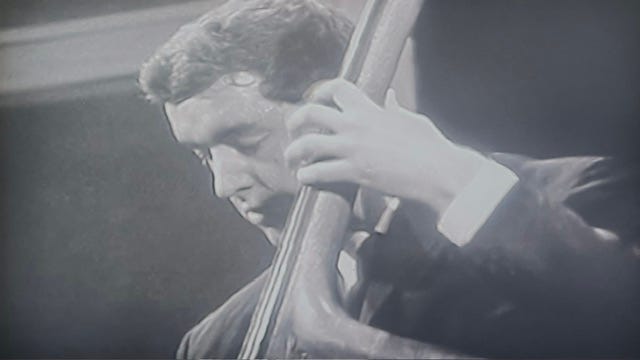
(Dave Green playing on BBC’s Jazz 625 in 1964. Picture: Still from BBC 2 broadcast)
Next week in part two: keeping an open mind, playing with Sonny Rollins and being a ‘reluctant band leader’
Dave Green will be playing with the Scott Hamilton Quartet at Pizza Express, Soho for seven nights on 27 August to 1 September 2026.
Matyas Gayer Trio’s (Matyas Gayer, Dave Green and Steve Brown) album Westbourne Park (2024) is on Ubuntu Music. A new album is expected later this year.