

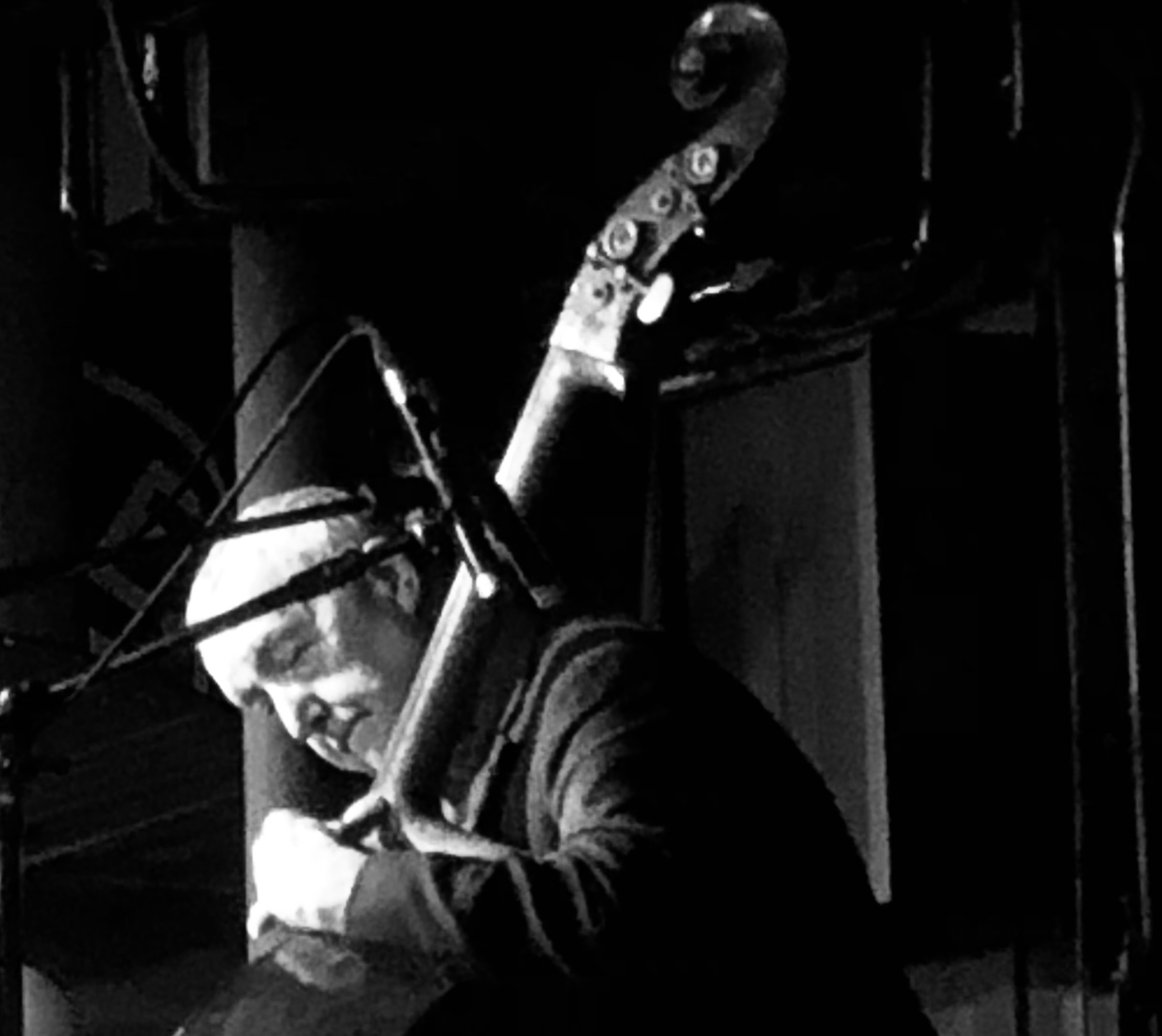
(Dave Green at Pizza Express Jazz Club, London, March 2022. Photo: John Earls, 2022)
The first part of this interview with British jazz legend Dave Green focused on his formative years. In this second and final part, Dave discusses his approach to making music and other reflections.
One of the things that strikes me most about Dave Green is not just the range of people that he has played with, but the scope of styles and formats too. It includes big band music (with boyhood friend and neighbour, Rolling Stone Charlie Watts, for instance), ABC&D [of Boogie Woogie], Humphrey Lyttelton’s band (with whom he played for 18 years), Pocket Ellington, Still Waters (trumpeter Henry Lowther’s band), the Scott Hamilton Quartet and Matyas Gayer Trio. I suggest that such a variety and range is something that Dave not only enjoys but thrives on. “I do thrive on that. I love it. I’ve got no restrictions. I’m open to anything in the music, really. I love even getting into free improvisation if it arises. I think basically I just love the whole history of the music. I’m a jazz fan. I still find that music so rewarding to listen to, in the ‘30s and ‘40s. So, I’m aware you get the stylistic different things and I’m very happy to play what is required in the music.”
Dave has also formed his own bands including the Dave Green Trio with drummer Gene Calderazzo and saxophonist and clarinettist Iain Dixon, who released two albums, Time Will Tell (2000) and Raise Four, where the trio were joined by renowned free jazz and free improvisation saxophonist Evan Parker in a 2004 recording for BBC Radio Three’s Jazz on 3 released in 2022 to mark Dave’s 80th birthday. I ask him what sort of challenge comes with leading a band?
“When I formed the trio I think I was playing with Scott [Hamilton] at Pizza [Express, Soho] and I heard Gene Calderazzo for the first time because they used to have late-night jams after the main gig. So I stayed behind, listened to a bit of Gene and was so impressed with him I thought, ‘I want to play with him, but how am I going to?’ I’m not a natural band leader. I’m kind of a reluctant band leader, if you like. And also when I heard Iain Dixon, who is a phenomenal musician, I thought the only way I’m going to play with these guys is if I form a trio. So I did and we made the record.
“About three or four years later, we did a broadcast with Evan Parker. I’m very proud of that record because I don’t like stylistic inhibitions. I’ve always hated that kind of, ‘Oh, this guy fits into this pigeon hole’, ‘this guy plays this way and this guy plays that way’. You’ve either got this feeling of freedom in your playing or you haven’t. That’s what I’m interested in. That feeling of not being predictable. I hate predictability in the music. I like surprise. And that’s what I try to do as a player. You can’t always do that, but that’s behind my thinking. Be open to improvisation in whatever context you’re in. You can play with a straight ahead mainstream band but you can still make it different.”
Dave also took on the band leader role for a quintet called Fingers, featuring Bruce Turner (alto saxophone and clarinet), Lol Coxhill (soprano saxophone), Michael Garrick (piano and a band leader himself) and Alan Jackson (drums). “I got that band [together], although again a reluctant band leader. I knew Michael for years, I was in and out of his band. That’s why I asked Michael to be with Fingers. Nobody would ask him [to be in a band] because he was a band leader. I said, ‘Mike, [join] my band’, and he was knocked out.”
I probe if it might happen again and whether there are people he thinks he’ll only get to play with if he is band leader. “Yeah, could do. You know, I might wake up with an idea and think ‘that’s a good idea’. Then it goes in the background a little bit. But I’m always very open, even in this late stage of my life.”
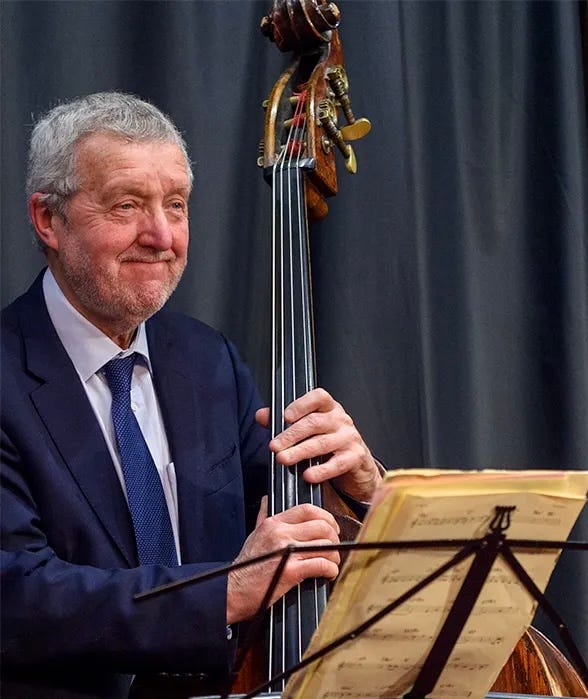
Dave’s current plans include a new album with the Matyas Gayer Trio which has been recorded and is due for release in the autumn. The trio’s previous album Westbourne Park was one of the musical highlights of 2024. At some of the Hungarian pianist’s band’s concerts this year, the sets have seen the influence of Hungarian classical and folk music. “On the new one I think we do three Hungarian folk songs which are beautiful. Very unusual form and structure. Five bar phrases as opposed to your normal kind of eight bars. It makes you think in a different way. I’m very happy with it.”
The trio is also notable for spanning some three generations with Gayer being in his mid-30s, drummer Steve Brown his late 50s and Dave something of the elder statesman. He clearly enjoys this form of variety too. “Yeah, at the moment, I’m playing with Alex Clarke’s quartet. I’m 84 and she’s 24. 60 years difference between us and we’re playing music together because she’s got a great open attitude about it. She’s an amazing player. I love her approach to the music. So, that’s a joy for me to share the stand with her.”
We talk a bit about what Dave does when he’s not making music. He’s something of an archivist, including radio comedy, and says that his “other life would be working for the BBC Archives”. He also collects recordings by German conductor Wilhelm Furtwängler and is interested in polar exploration. He likes to take walks around his local Ruislip Lido but admits, “I’m always thinking. We’re talking now, but the music’s always there.” Is it difficult to switch off? “It is, yeah. Wake up, think about the gig the night before. It’s always going through your head. And ideas come and go.”
Having alluded a few times during the interview to his diaries and own archives, I ask a question he must have been asked many times. What about a biography or autobiography? “Well, the diaries help. But I always think maybe that’s something I should do when I’ve stopped. But I don’t want to stop at the moment. I’ve still got a few ideas and things I’d like to do. So, it’s a possibility before I get to ‘nine-o’ (90).
“And the thought does occur to me, as you mentioned, I’m the last one from Jazz 625. It’s important, isn’t it? Whatever I say, I’m not totally profound or whatever, but, once I go, there’s nobody left who was on Jazz 625. I dug out a tape the other day when I worked with Coleman Hawkins - that statement alone, it’s ridiculous, even now, I think, did I actually work with Coleman Hawkins? But I did, and he was a wonderful guy. As I’ve discovered, all those guys are. They’re giant musicians, but they’re wonderful people as well.”
I tell him that his stories add a real qualitative dimension to the history, providing colour to the fact-checking. Such as his time with Sonny Rollins. “I know. Human stories. That was Sonny, though. I was in total awe of him. Previously I’d done the Roland [Kirk] gig. We got on like a house on fire. That was 1966. And then I think Ben [Webster] came over after that. He was friends with Jimmy Blanton, my idol. The whole thing was almost too much for me to take. And then Ronnie [Scott] asked me to do Sonny. This is unbelievable. It turned out he was the most wonderful human being.”
Dave tells me about phoning Sonny Rollins after many years and how he had to pluck up the courage to do it after so long and how, when Rollins comes on the line, he says, ‘Hey, Dave!’ as if it was like yesterday.” I tell Dave that even now, he speaks like a fan. “Yeah, I am. I still can’t believe I worked with him. I remember we did Klooks Kleek [club] in West Hampstead, and Ronnie Scott drove us to the gig, and at that time I had been playing with Michael Garrick and Don Rendell and we’d been using Indian scales - ragas and stuff. I must have played something during the gig with Sonny, kind of slightly influenced by what I’d been doing with Don, in an Indian way, a phrase or something. When we got in the car, he said, ‘Hey, Dave, you played that Indian thing, man. Like that!’. Things like that just stay with you the rest of your life.”
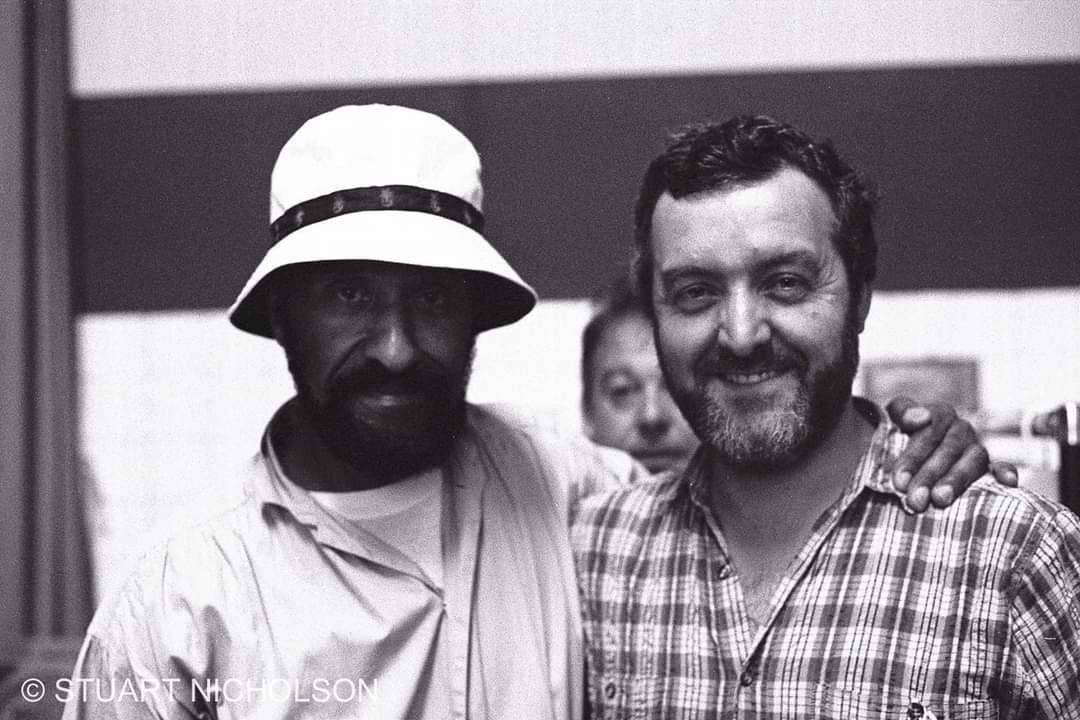
(Sonny Rollins and Dave Green backstage at the Market Hall at the Brecon Jazz Festival, August 1989. Photo: Stuart Nicholson)
As we finish up, I ask Dave if when he played together with Charlie Watts in the later years, after their respective successful careers were established and thriving, did they ever look up at each other and say, ‘that’s the bloke I went to school with?’ “Oh yeah. It was incredible. The first time I heard Charlie Parker was in Charlie’s bedroom when we were about thirteen. He bought this Charlie Parker record, the famous Massey Hall concert, when we were teenagers. And then many years later we played Massey Hall with [Charlie’s] Big Band. I remember we did two nights. Massey Hall! That magic recording. The whole thing about it was gigantic in our minds. And there we are on stage at Massey Hall and he looked over to me and went, ‘Made it!’ You didn’t have to say anything. It went back to when we were kids. Just that moment on stage. Incredible. Brings tears to my eyes thinking about it actually. Just amazing.”
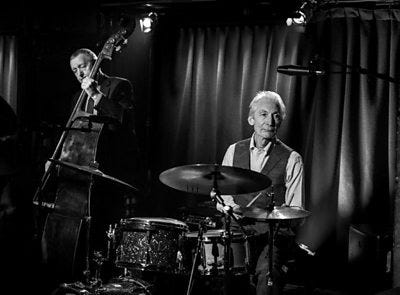
(Dave Green and Charlie Watts in Jazz 625: For One Night Only 2019. Picture: BBC 4/Somethin' Else)
And so we end where we came in. Talking about his dear friend Charlie Watts. But this has also been a conversation full of enthusiasm about many musicians Dave Green has played with and still admires, and the love of the music he continues to make. He may be a ‘reluctant band leader’, but he continues to be a positive force and an example to us all.
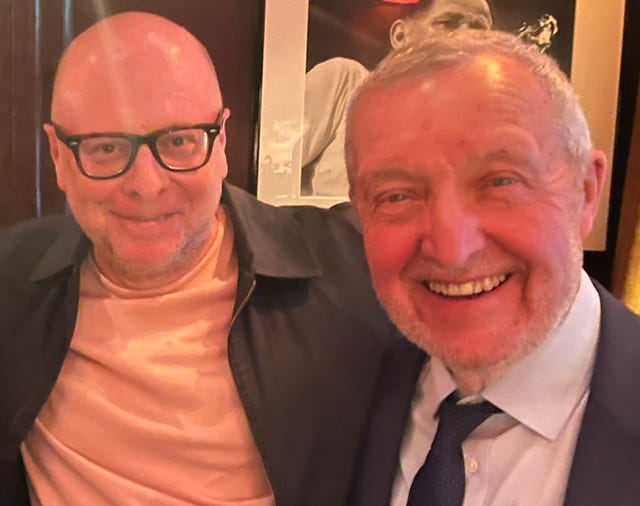
(The author with Dave Green at Ronnie Scott’s Jazz Club, June 2026. Photo: Adrian Weir)
Dave Green will be playing in the Scott Hamilton Quartet at Pizza Express, Soho for seven nights on 27 August to 1 September 2026.
Matyas Gayer Trio’s (Matyas Gayer, Dave Green and Steve Brown) album Westbourne Park (2024) is on Ubuntu Music. A new album is expected in the autumn 2026.